
Lytchett Minster Solar Farm
Introducing Lytchett Minster Solar Farm
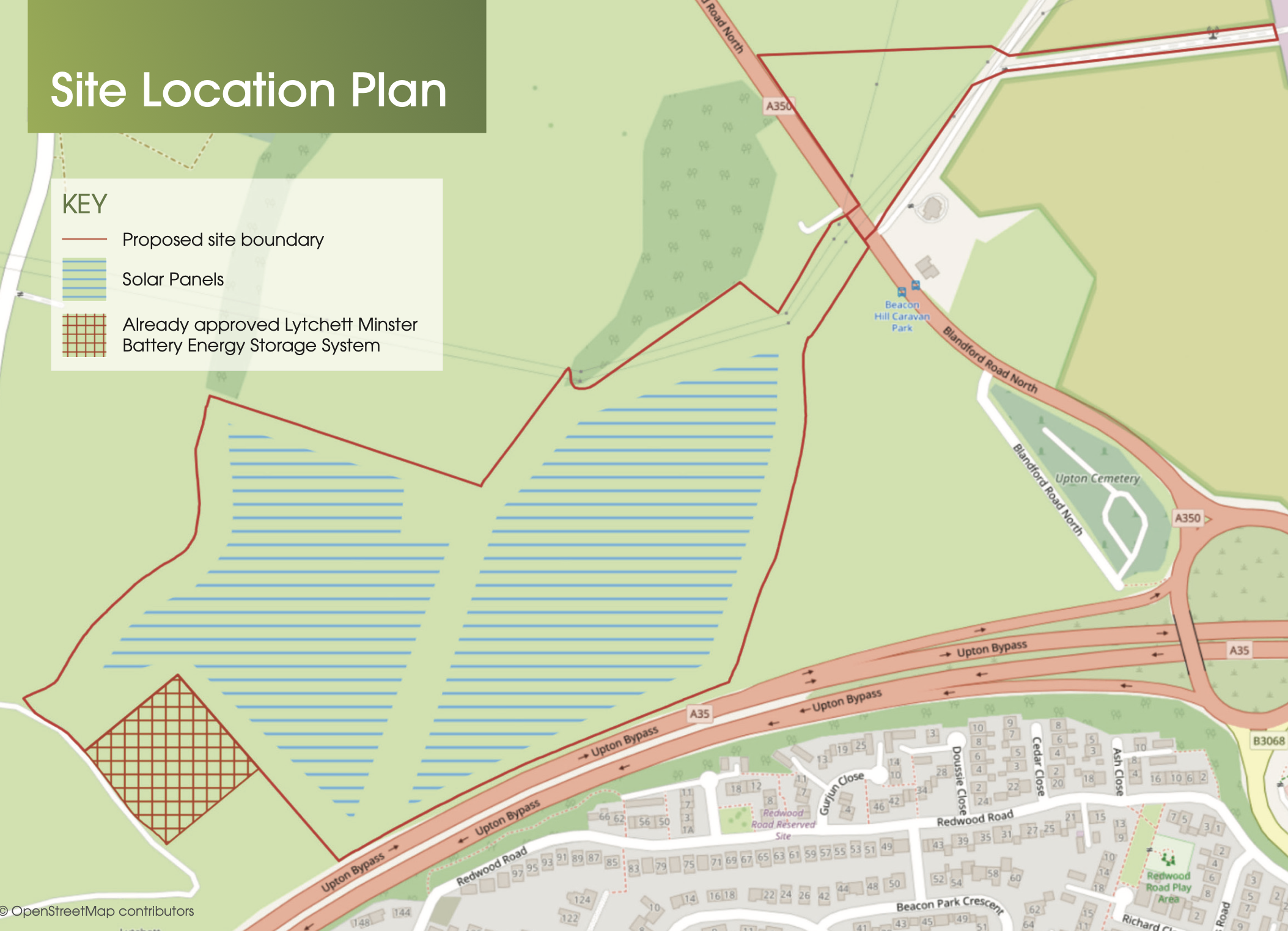
Green Nation is working to bring forward plans for Lytchett Minster Solar Farm located on land at Post Farm, Lytchett Minster.
Green Nation invites you to learn more about the proposed Lytchett Minster Solar Farm and to engage in the early stages of the public consultation process. We are proposing to develop a solar farm located on land at Post Farm, Lytchett Minster.
The solar farm will have a generating capacity of up to 12MW for distribution to the National Grid. This is equivalent to the annual electrical needs of approximately 4,300 homes, while the anticipated CO2 displacement is around 1,400 tonnes per year (DUKES, 2025; DESNZ, 2025).
Local Benefits of the Solar Farm
It will assist Dorset Council’s ambition in reducing greenhouse gas emissions in line with local and national targets in response to the Climate Emergency.
It will contribute towards the security of energy supply in Dorset through the provision of local, renewable electricity.
Helping to support an increased number of plant and animal species, including protected species, within the solar farm site.
The site will promote long term soil improvement and protection as well as provide carbon storage and recycling.
Good design and careful positioning limit the impact to the landscape.
The site will allow the land to rest and will be returned to full agricultural use at the end of its life span (40 years) through the provision of a planning condition.
Public consultation
We would like to thank attendees for attending our pubic consultation event on the 2nd of June at The Upton Social Club.
About us
Founded in 2011, Green Nation has been a leader in the energy transition for over a decade. We have developed solar farms across the country and worked with hundreds of homeowners and businesses to install rooftop solar, supplying clean energy to the grid.
We currently manage 75 solar farms and more than 700 rooftop installations across the country. Our solar farm portfolio totals over 200MW of electricity producing capacity for businesses, communities and neighbourhoods.
We continue to grow and expand our portfolio - aiming to make solar power and renewable energy work effectively at scale. We are committed to developing sensitively designed projects, working with landowners and local communities to maximize the benefits of
our projects.
Frequently Asked Questions
-
The Climate Emergency, the cost-of-living crisis and the energy crunch are all linked by how we generate, use and supply energy. We urgently need to generate energy from new, low cost, low carbon sources and solar is the lowest cost and quickest to deploy of all energy sources.
The proposed solar farm will generate renewable electricity integral to the UK Government’s overarching policy to provide significant reductions in national greenhouse gas emissions and improved energy security. The Government’s Energy Security Strategy (2022) proposed a five-fold increase in solar by 2035. Lytchett Minster Solar Farm will assist in helping the UK reach this target and create a greener, cleaner energy future for Dorset.
-
For our solar farm projects we require a nearby grid connection, a well-screened site that is consistent with planning policy and a supportive landowner. Lytchett Minster Solar Farm offers all these features.
-
The solar farm is a temporary development and will not change the land classification from agricultural greenfield to commercial/industrial brownfield. In effect, it will remain agricultural land when the solar farm has been decommissioned.
-
No, solar panels have no moving parts and emit no sound. Inverters and transformers can emit very low- level sound, but these are sited away from houses and cannot be heard from more than a few metres away.
-
The UK Food Security Report (2021) found that “the biggest medium to long term risk to the UK’s domestic production comes from climate change and other environmental pressures such as soil degradation, water quality and biodiversity”.
Solar farms currently account for 0.08% of total land use in the UK (Solar Energy UK 2022). The Government targets for a fivefold increase in solar would result in 0.3% of the UK land area being used by solar (Carbon Brief, 2022). This is the equivalent to around half of the space used by golf courses.
-
Will the solar farm harm wildlife?
There is no evidence that solar farms have a negative impact on wildlife. In fact, wildlife thrives within the sites when managed sensitively.
Research from organisations including the University of Cambridge and the RSPB has also demonstrated that sensitively designed solar farms can support a greater prevalence of birds, pollinators and other wildlife compared to intensively farmed land.
The project aims to deliver a Biodiversity Net Gain. Measures currently being considered include the creation of species-rich grassland and wetland meadow habitats to improve the health and connectivity of the local ecosystem. Additional measures include bird and bat boxes, reptile hibernacula, habitat piles, and native scrub planting to support wildlife movement and provide natural screening.
-
It typically takes 6 to 9 months to build a solar farm of this size. Site working would typically be Monday to Friday and Saturday mornings only.
Tell us what you think
Please complete the feedback form you received in the post or fill in form below.
Any information provided will only be used for the purpose of the planning application to the Local Planning Authority and will not be disclosed with any third parties.